Bean-to-bar literally means from the bean to the finished bar
It sounds simple.
Yet those three words describe a very different way of thinking about chocolate.
A bean-to-bar maker starts with cacao beans rather than buying finished couverture and simply melting it into a new shape.
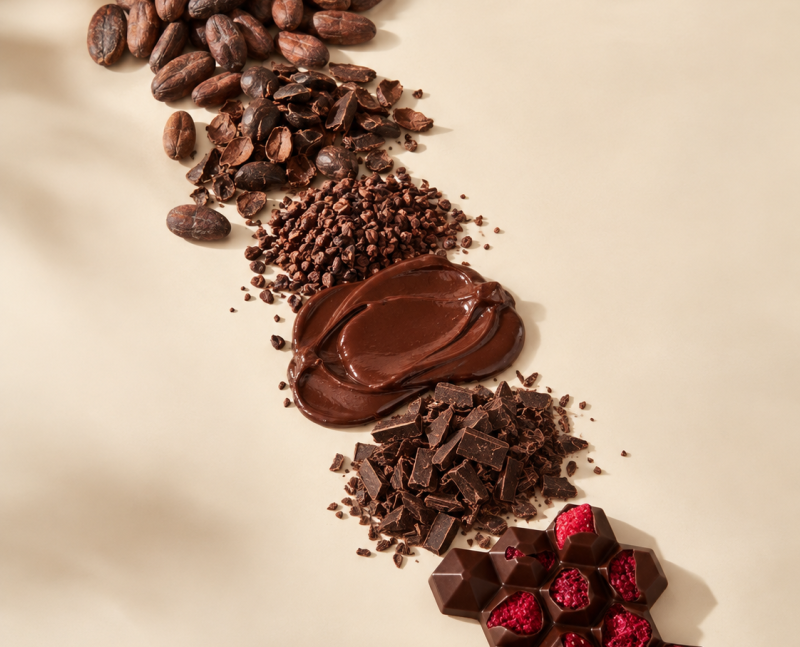
The beans are selected, roasted, cracked and winnowed. The cacao is ground and refined. A recipe is built around it. The chocolate is stabilized, tempered and finally molded into a bar.
That control over the transformation is the core of bean-to-bar chocolate.
It is important, however, not to turn the term into a magic quality badge. Current research on bean-to-bar chocolate makes the same distinction: making chocolate from the bean gives the maker more control, but the final quality still depends on the cacao and on how well every stage is executed.
“But large chocolate factories use cacao beans too”
They do.
Bean-to-bar does not mean that every industrial chocolate maker buys pre-made chocolate while every small maker is uniquely processing whole beans.
Some large manufacturers operate fully integrated cocoa-processing systems.
The difference is better understood through the problem each model is trying to solve.
When you make millions of bars for multiple markets, consistency is essential. A customer expects the bar they buy next year to taste almost exactly like the one they bought today.
Craft bean-to-bar makers can approach variation differently.
A new harvest does not necessarily have to be engineered into the same flavor.
It can be explored.
.png)
Cacao is an agricultural product
Like coffee or wine, cacao changes with genetics, climate, soil, fermentation, drying and storage.
That is why “Peru” or “Venezuela” on its own tells us very little.
We want to understand the actual lot.
How was it fermented? How was it dried? Was it stored correctly? What does it taste like before we decide what to do with it?
Our partner works directly with cacao producers in Venezuela and evaluates cacao there before selected lots are sent to Ukraine.
Then the maker takes over
Even extraordinary cacao can be handled badly.
Roasting too aggressively can flatten delicate aromas. A different recipe can change both texture and flavor perception. Refining determines whether the chocolate feels grainy or almost fluid as it melts on the tongue.
At YANDMI, roasting is adapted to the specific cacao in front of us.
After roasting and winnowing, the chocolate spends several days under stone grinders until the texture becomes exceptionally smooth.
And that is where cacao starts to become more than “chocolate flavor.”
You may find fruit, caramel, nuts, wood, flowers or spice.
Without those flavors ever being added.
Bean-to-bar vs mass-produced chocolate
This is not a simple battle between “good” and “bad.”
Mass-produced chocolate solves an important problem extremely well: availability, consistency and price.
Bean-to-bar is designed around another question:
What can this particular cacao taste like?
That is why craft makers tend to talk more about origins, fermentation, harvests, roasting and cacao percentages.
It is also why two 72% bars can taste almost unrelated.
.png)
What bean-to-bar means at YANDMI
For us, it is not packaging language.
It is the decision to begin with a raw material we can see, evaluate and understand.
To choose cacao.
Figure out what it needs.
Avoid forcing every origin into one standardized “chocolate” profile.
And eventually let you taste the difference.
Because the most interesting part of bean-to-bar is not learning the definition.
It is tasting a bar and suddenly thinking:
“Wait — cacao can taste like this?”