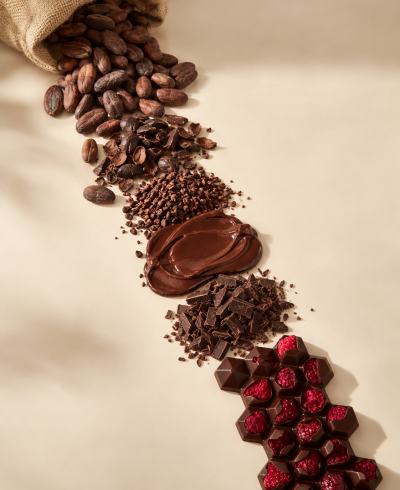
White chocolate actually begins with cacao
That is the first contradiction.
It is not brown.
It does not carry the roasted bitterness associated with dark chocolate.
So people often ask whether white chocolate is “real chocolate” at all.
Yet its defining ingredient comes directly from the cacao bean:
cocoa butter.
Cocoa butter is the natural fat in cacao and a major reason chocolate behaves the way it does — remaining solid at room temperature and then melting smoothly in the mouth.
What is white chocolate made of?
Standards in major markets define white chocolate around cocoa butter, sugar and dairy ingredients.
In the United States, for example, the FDA standard requires at least 20% cocoa butter and specifies dairy ingredients as part of the formulation. European-style definitions follow the same basic structure.
So yes, white chocolate contains something from cacao.
It simply does not contain the dark non-fat cocoa solids that create the familiar brown color.
.png)
Then there is YANDMI 26%
It may visually remind you of white chocolate.
It is creamy, too.
But the recipe follows a different logic.
YANDMI chocolate is plant-based, so we do not add milk powder. Nor do we use plant milk simply to create a one-to-one imitation of conventional white chocolate.
Instead, 26% is built from:
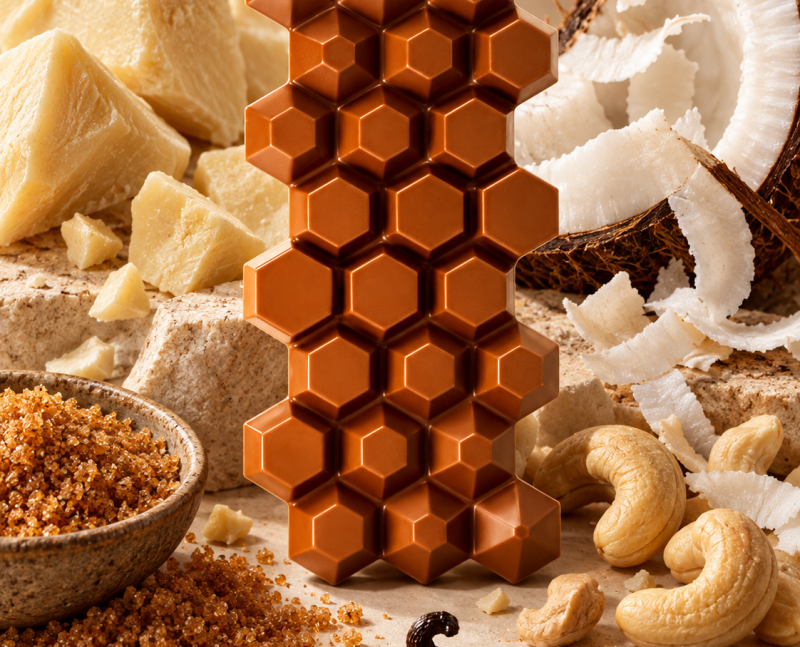
cocoa butter, cashews, coconut, coconut sugar and real vanilla.
Each one has a job.
To understand how the numbers on chocolate work, read our guide to cocoa percentages
How do you create creaminess without milk?
Cashews give the chocolate body and natural creaminess.
Coconut adds a subtle nutty layer.
Cocoa butter creates the melt.
Real vanilla brings everything together without reducing the flavor to generic “vanilla sweetness.”
The result is soft, buttery and long-lasting.
Custard is one of the comparisons we hear most often.
Why is it not bright white?
Because real ingredients do not have to be.
Cocoa butter naturally ranges from ivory to pale yellow. Cashews, coconut sugar and vanilla add their own warm tones.
You can even see tiny dark vanilla seeds throughout our 26%.
We have no interest in hiding them.
What about other vegetable fats?
Confectionery coatings can use other fats instead of some or all of the cocoa butter.
There are legitimate technological reasons for doing that — including cost, heat stability and manufacturing behavior.
That does not automatically make them “fake.”
It makes them a different type of product.
For YANDMI, the question is simpler.
We want the melting behavior and texture that cocoa butter gives us.
So we use it.
Why simply call it 26%?
Because traditional chocolate categories do not describe our collection particularly well.
26% is the softest.
40–45% remain creamy but become progressively more cacao-forward.
72%, 80% and 100% move the focus further and further toward cacao itself.
So rather than trying to squeeze 26% into a familiar label, we prefer another idea.
Taste it.
And let it be its own thing.
Discover the Unusual 26% bar, then compare profiles from 45% to 100% in the Gallery of Flavours
.png)