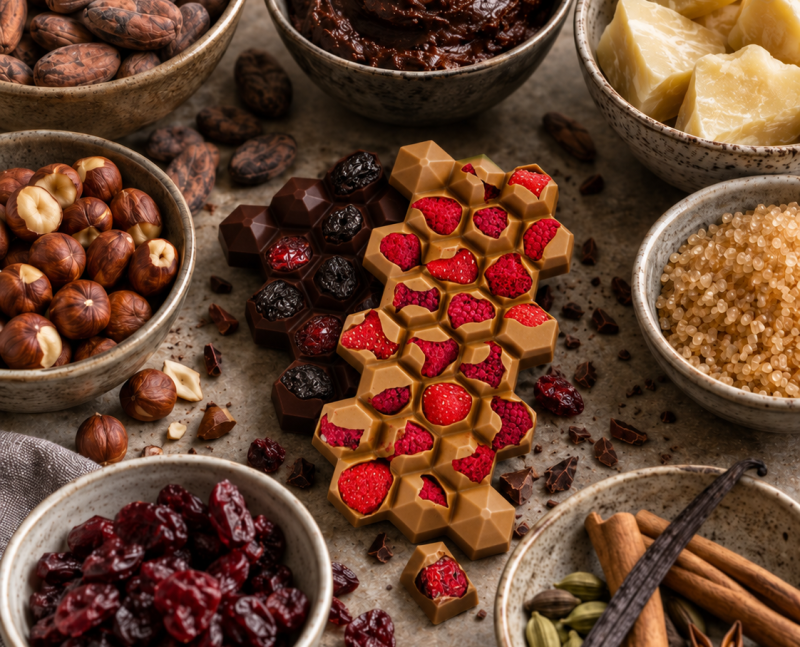
The biggest “lie” about chocolate is more complicated than it sounds
We could tell you that the entire chocolate industry is hiding the truth and that every supermarket chocolate bar is fake.
It would make an excellent headline.
It would also be wrong.
The real story is much more interesting.
Chocolate sits at the intersection of agriculture, commodity markets, complex food technology, millions of farming households and enormous international manufacturing systems.
That is where the compromises begin.
Why cocoa butter matters
Cocoa butter is the natural fat in cacao beans and one of the reasons chocolate behaves like chocolate.
It is solid at room temperature and melts rapidly close to body temperature, creating the smooth melting sensation associated with well-made chocolate.
The confectionery industry also uses alternative fats in some products. They can reduce cost, simplify processing or improve heat resistance.
This is the world of compound chocolate and confectionery coatings.
It is not a secret conspiracy.
It is a different product technology.
Vegetable fat does not automatically mean fraud
Chocolate standards vary between markets.
European rules, for example, allow certain chocolate products to contain a small percentage of specified vegetable fats in addition to cocoa butter.
And cocoa powder is not simply “industrial waste.” It is a regulated cacao product made by processing roasted cacao beans after the shell has been removed.
That is why reading a label requires context.
Look at the complete formulation, the product name and the role each ingredient plays.
.png)
The other side of chocolate is cacao sourcing
Most of the global market is bulk cocoa, produced and traded at large scale.
Fine flavor cacao occupies only a small fraction of global production and places much greater emphasis on origin, fermentation, sensory quality and traceability.
This is where chocolate begins to resemble specialty coffee or wine.
Chocolate is also about people
Most cacao is grown by smallholder farmers, and low farmer incomes as well as labor issues remain major challenges across parts of the global cocoa supply chain.
For us, traceability is therefore more than packaging language.
We want to understand where a particular lot comes from, who worked with it, how it was fermented, how it was dried and how it was stored.
Our partner works directly with cacao producers and evaluates cacao before it is shipped to Ukraine.
This is not “mass market versus good chocolate”
Mass-produced chocolate is not automatically bad.
We have simply chosen another model.
Make less. Know more about the raw material. Give individual cacao lots enough space to retain their own character.
For us, that is what luxury in chocolate means.
Not gold packaging.
A product with nothing to hide.